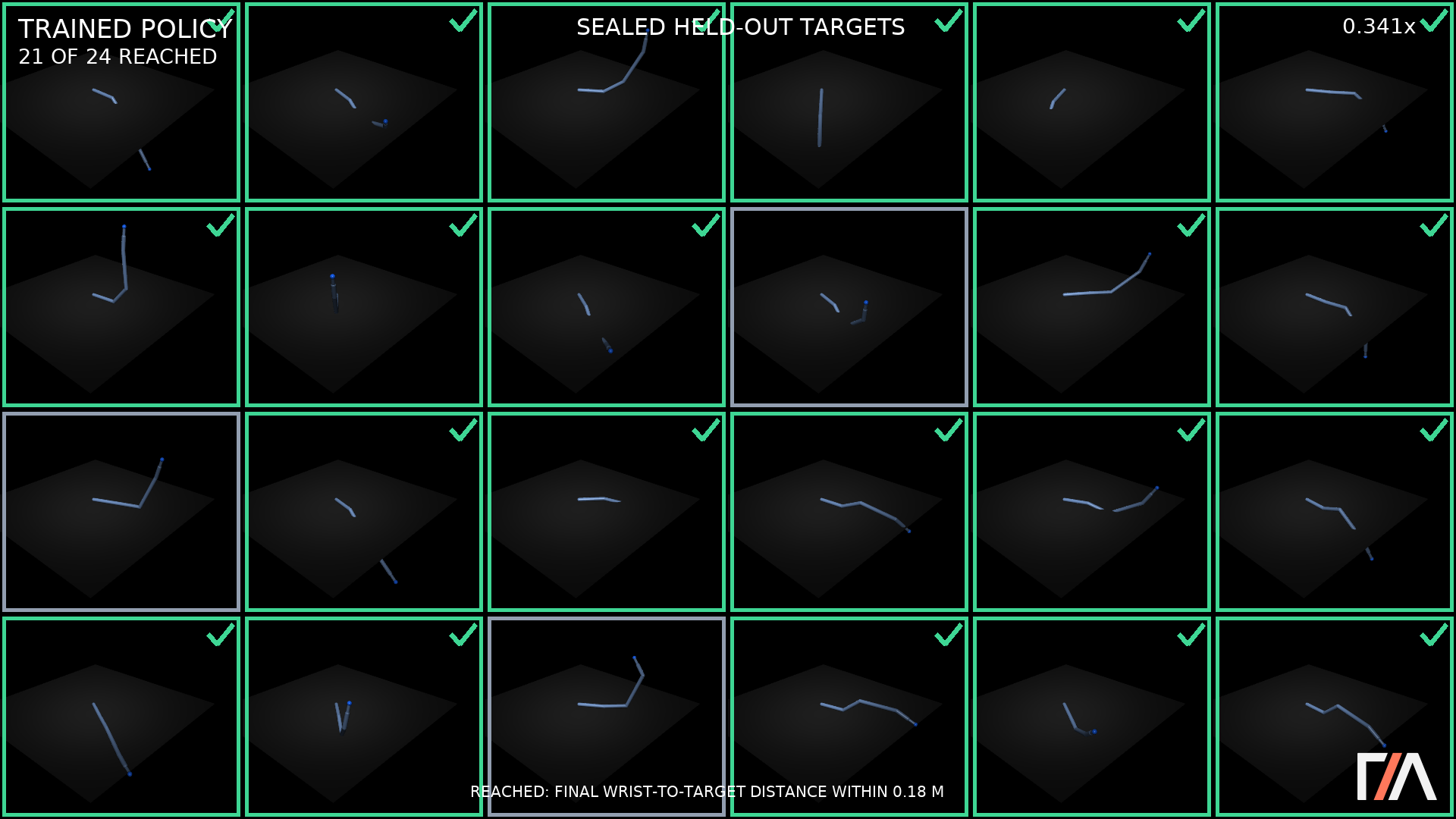
Video transcript
00:00 to 00:08
Trained policy
Sealed held-out targets
21 of 24 reached
Reached: final wrist-to-target distance within 0.18 m
0.341x
00:08 to 00:12
Untrained initialization
Sealed held-out targets
0 of 24 reached
Reached: final wrist-to-target distance within 0.18 m
0.683x
00:12 to 00:20
Evaluated envelope
Simulation, zero-gravity primary regime, one embodiment
486 of 600 motions, over the pre-registered 24-90 mm commanded-stop standoff distribution
Evidence provenance
- Competence trace
sha256:8ff3c00f122a7eb169d8acd9b4880594bf4c4435e81271cf25c28e16b598f252- Baseline trace
sha256:8c2531756f53ed54d6608885f258c4d89083d4d0703e4babc78df13b262c1e27- Engine
bfb3edc4efa8c3bcb9af53904dc28fa00b62b100- Command
kairos robotics reproduce- Root manifest
sha256:183be1e0e697aeda9212f3f2d164fad3c0fcb458754c6c59e0fa8776b64f9d4c- MP4
sha256:59498624d84beee51d2b1374a013db1c603fb180e66a0c7c5676c354b13d109c- WebM
sha256:708c1a4a0dd895a6bc7b06a3ef06baa975f437deea2a71f9888c4e380ff93df7- Poster
sha256:b5721266e1e1ccab3f30c6f404ce7922c4a14b4f666a2a7a0ea9076d5f645dec
1. What Was Measured
A held-out score is worth exactly what the discipline around it is worth. Every guarantee below rests on the set being sealed first and read once.
One learned six-degree-of-freedom reach policy was scored against 24 sealed held-out targets, in a single look, under a pass bar fixed and digest-anchored before the score. The measured quantity is deterministic held-out task success. The same policy at its untrained initialization was scored on the same targets in the same look, as the baseline.
The method around that score is KAIROS validation. It fixes a success bar and a sealed held-out set in advance, scores the policy against that set exactly once, and writes replay evidence that re-derives bit-for-bit from committed bytes.
This record covers one such certification: a learned reach policy carried through the method to a recorded verdict. The training and certification recipe stays withheld. The claim is task competence within a measured interpolation geometry.
1.1 The System Under Test
The certified policy is a neural controller for a simulated six-degree-of-freedom position-controlled arm, running a fixed-horizon reach task in MuJoCo through a Gymnasium adapter. The policy observes proprioceptive state and a target, and commands position setpoints. Task success is a deterministic geometric predicate: the end effector rests within the success radius of the target at the end of the episode.
| Parameter | Value |
|---|---|
| Degrees of freedom | 6 |
| Simulator | MuJoCo, via a Gymnasium adapter |
| Observation | proprioceptive state plus target |
| Episode | fixed horizon, 512 steps |
| Success radius | 0.18 m |
| Policy architecture | 41-256-256-6 multilayer perceptron |
| Certified policies | 5 seeds, validation success 0.86 to 0.98 |
The frozen artifacts are the five policies that passed the training gate, each pinned by a policy digest and selected before any held-out contact. The primary gate policy is the median-validation seed 5105713, chosen by validation score alone.
1.2 How the Policy Was Trained
The policy is produced by behavioral cloning. A scripted teacher controller solves each development-tier scenario, and the network is fit by supervised regression to reproduce the teacher’s commanded action at every observed state. The 41-256-256-6 multilayer perceptron above is that regressor.
Teacher labels are partitioned along with the targets. Development-tier labels train the network, validation-tier labels are withheld from training and used for selection, and held-out-tier labels stayed sealed behind the access guard until the single certifying look. The harness enforces that partition directly: a request for a held-out label outside the authorized look raises and halts the run.
Rollout-augmented variants were screened during development, in which the policy’s own visited states are relabelled by the teacher and folded back into the training set. That family addresses the compounding drift a cloned policy accumulates once its trajectory leaves the teacher’s distribution.
The gate above the policy is agnostic to all of this. It observes rollouts on sealed targets and scores a geometric success predicate, so it reads behavior alone. Carrying the same gate onto policies produced by other training methods, reinforcement learning among them, is future work.
1.3 Cohort Partition
The cohort is partitioned into three tiers by geometric target separation: a development tier for building, a validation tier for selection, and a held-out tier of 24 targets sealed behind an access guard for the single certifying score.
Target separation at the success radius is asserted across all partitions, so the tiers are geometrically disjoint. Disjointness is a property of the geometry rather than of the identifiers, and the validator asserts it directly.
1.4 The Pre-Registered Rule
The pass bar was fixed and digest-anchored before the held-out score.
- Primary metric: deterministic held-out task success for the primary policy.
- Primary bar: one-sided Wilson lower bound at or above 0.50 over 24 episodes
(
z = 1.645), which requires 17 of 24 successes. - Secondary bar: a point lift of at least 0.25 over the same policy at its untrained initialization.
- Written prediction: an expected count of 22.48 of 24, with a central 90% band of 21 to 24, recorded before the score.
The held-out set was reached exactly once in the program’s life. An access guard admitted the held-out score only against the pre-registered freeze-manifest digest. The four secondary policies were scored in the same single look.
2. Results
Certification here names the verdict that the pre-registered rule emits over the sealed cohort. It is a property of this measurement, anchored to the digests in section 4.
2.1 Certified Result
| Property | Result |
|---|---|
| Primary policy held-out success | 21 / 24 (0.875) |
Primary Wilson lower bound (one-sided, z = 1.645) | 0.725, above the pre-registered 0.50 bar |
| Point lift over untrained initialization | 0.875, above the 0.25 bar |
| Certified policies clearing the bar | 5 of 5 |
| Prediction band (pre-registered 21 to 24) | confirmed at 21 |
| Verdict | GO |
2.2 Per-Seed Counts
All counts below come from the same single look.
| Seed | Role | Successes | Rate |
|---|---|---|---|
| 5105713 | primary gate | 21 / 24 | 0.875 |
| 5105716 | secondary | 22 / 24 | 0.917 |
| 5105717 | secondary | 20 / 24 | 0.833 |
| 5105714 | secondary | 19 / 24 | 0.792 |
| 5105715 | secondary | 19 / 24 | 0.792 |
| 5105713 (untrained init) | baseline | 0 / 24 | 0.000 |
The primary policy alone bears the gate. The four secondary counts are reported for completeness within the same look. The untrained initialization of the primary seed reached zero of 24, isolating the trained policy as the source of the measured competence.
3. Boundaries of the Certified Claim
The limits are stated first. Each one bounds the certified claim to the region the measurement covers.
- Task competence. This certifies that the policy reaches its targets. The claim is confined to reach competence, and runtime safety is a separate certification, reported in the companion record.
- Simulation, single embodiment, reach-only. The result holds in MuJoCo, on one 6-DoF arm, for a position-controlled reach task. The simulation-to-hardware transition is future work.
- Corpus-conditioned interpolation geometry. Competence is certified for targets inside the measured interpolation band. Beyond a 0.28 m corpus distance the learner family reached 0 of 21. The certified geometry is the interpolation region, and behavior outside it is a stated limitation.
- Held-out resolution. The bar is a one-sided lower bound over 24 sealed targets. The 24-episode denominator sets the resolution of the Wilson bound, and a larger sealed cohort tightens it.
- Reachability established independently. A committed teacher reaches every held-out target at a task-success rate of 1.0, so the bar tests the learned policy against feasible targets.
- Training diagnostics stay separate from the gate. Supervised-fit metrics during training are diagnostics. The certified verdict rests on held-out task success alone.
4. Provenance and Reproduction
Every artifact is anchored to a content digest. A change to the bar, the cohort, or a scored value produces a different digest, so the basis of the verdict is fixed and inspectable.
| Artifact | SHA-256 |
|---|---|
| Certification summary | f8ff666b83cc00be53d1d03c6fb27d3f281630727f5c4c1801ee3fffab981354 |
| Frozen decision | 0597b3cefe5c09627e9270905d7b408cc39bb11b57b2f8db5886db07be812805 |
| Sealed held-out cohort | 550155ec9b67156f767e0c6185f7b1056fb4bcca668aab2089155c44a0ac46e3 |
| Primary policy | 08734aed26986c6ff08ab6ffa68b909d3f82ce7c6741c664d65c94446cad35b5 |
| Single-look ledger | 9c299aeda7aac1287e1968a0cb2759d17b941c8a73c110c59a431b0ab090b713 |
The certifying run emitted an auditable single-look ledger. A repeat evaluation of the primary policy reproduced its trace digest and its counts exactly. Export and reload fidelity checks passed before scoring. The evidence package re-derives the verdict, the count table, and the trace digests from committed bytes.
Packaging the certification bundle and the standalone verification command for public distribution is in progress.
5. Study Configuration
Task
- Environment: MuJoCo 6-DoF position-controlled arm via a Gymnasium adapter
- Episode: fixed horizon, 512 steps
- Success predicate: end effector within 0.18 m of the target at episode end
- Observation: proprioceptive state plus target
Policy
- Training: behavioral cloning by supervised regression on scripted-teacher actions
- Architecture: 41-256-256-6 multilayer perceptron
- Certified seeds: 5105713 (primary), 5105714, 5105715, 5105716, 5105717
- Validation success range: 0.86 to 0.98
- Primary selection rule: median validation score
Gate
- Bar: one-sided Wilson lower bound ≥ 0.50,
z = 1.645, over 24 episodes - Required count: 17 of 24
- Secondary bar: point lift ≥ 0.25 over untrained initialization
- Looks: one, admitted by access guard against the freeze-manifest digest
- Freeze manifest:
sha256:0597b3cefe5c…
6. Standing
The durable asset is the certification method: pre-registered success predicates, tiered geometric cohort separation, single-look held-out discipline, and digest-anchored replay. The learned reach policy is the demonstration substrate. The method carries to any system with a crisp success predicate.
A measurement taken once, against a bar written down beforehand, against targets sealed beforehand, produces a number that stands on its own. Everything else in this record exists to make that single number checkable.
The companion record, Zero Hazards. Eighty-One Percent Recovered., certifies runtime safety and operability for the same class of embodiment under the same replay discipline.
This record states a simulation task-competence outcome only and carries no safety, hardware, legal, or investment claim.