Rosetta Robotics Adapter
A Safety Substrate for Vision-Language-Action Models
The Robotics adapter translates the Substrate's structural-margin reading into the forces governing physical AI. Motion is evaluated outside the behavior policy, delivering deterministic guarantees for kinetic hardware.
Substrate sits between the behavior policy and the motion planner.
It evaluates every proposed action in under a millisecond and issues a verdict on the same MCU as the low-level controller.
Two structural variables compute the verdict:
ΛLambda: Motion Aggressiveness
The momentum and optimization horizon a trajectory represents.
In physical AI, this calculates kinematic load; the velocity, acceleration, and forward commitment of a proposed actuator trajectory.
ΓGamma: Reachability Margin
The topological distance to a structural boundary or collision state.
The robotics adapter computes this as the buffer between active drift and a hard joint, obstacle proximity, or safe set boundary.
The Physics of Distribution Shift
Resource scarcity enforces the boundaries of physical action. Reinforcement learning optimizes for statistical alignment within a simulated environment. These neural policies operate exclusively in the semantic layer, calculating an average response for states they have previously observed in the training corpus.
Physical deployments inevitably encounter structural distribution shift. When the environment presents a novel geometry, such as an undocumented obstacle or an unmapped human pose, the policy defaults to its statistical mean. The agent executes this generated trajectory directly into the physical infrastructure, translating a probabilistic error into a kinetic collision.
This architecture creates an unresolvable vulnerability. The hardware attempts to execute a software hallucination at full mechanical torque. Behavioral alignment depends entirely on the agent recognizing the hazard, leaving the operational envelope exposed the moment the policy's categorization yields.
A Digital Nervous System for Physical AI
The motion planner is too far from the actuators to react to physical danger by reasoning. KAIROS Substrate closes that gap with sensation. The nervous-system metaphor is literal: the engine routes structural signals back into the planning loop at every control tick, the way proprioception routes joint position back to the motor cortex.
The gate is the reflex arc: every motion proposal is evaluated before it reaches the actuators, and a proposal that breaches the envelope returns to the planner. The continuous reading is the sense of touch: the planner feels structural pressure building and steers away before the reflex has to fire.
The gate carries the guarantee; the nervous system carries the operability. A robot that senses the boundary early spends its motion budget on the task.
The reading rides the response envelope the gate already returns: one integration, two functions. The engine, the robotics adapter, and the validation harness run today, embedding beside the low-level controller through a thin C FFI.
One Envelope. Four Lifecycle Stages.
One deterministic margin reading serves the robot from first simulation to fielded audit. Each stage consumes the reading at a different point in the lifecycle, and each stage leaves committed evidence behind.
Calibrate
Train
Deploy
Validate
Measured Containment
Nothing on this page is conceptual. Every claim above is implemented and measured: a frozen build of the robotics gate was scored once against a pre-registered cohort of 1,800 MuJoCo scenarios, with the scenario set, the acceptance criteria, and the statistical thresholds committed before the run.
The layer accepted zero collision hazards. A velocity-blind baseline gate, scored on the same cohort, accepted 1,200. Every hazard the baseline passed, the layer removed.
Containment has an operability price, and the price is on the invoice: of the motion that is unsafe at full speed and recoverable when slowed, the layer preserved 81% by constraining speed, at zero added hazard.
- Cohort
- 1,800 scenarios, pre-registered and digest-anchored before measurement
- Collision hazards accepted
- 0 of 1,800. The baseline gate accepted 1,200 on the same cohort
- Hazards removed vs baseline
- 100%
- Recoverable motion preserved
- 81% at zero added hazard, certified lower bound 0.76
- Scoring
- One pass, family-wise corrected Wilson intervals
- Reproduction
- Byte-identical replay from committed evidence, simulator-free
The contract is exact: KAIROS gates motion proposals, returns unsafe proposals to the planner for reformulation, and records every verdict for later evaluation.
Structural Proof of Compliance
From 20 January 2027, Regulation (EU) 2023/1230 is the sole route for placing machinery on the EU market, and machinery with self-evolving safety behaviour faces notified-body conformity assessment. Learning-based machinery has an evidence problem: the safety case rests on behaviour that changes. KAIROS produces the decision record that assessment consumes.
Deterministic Verdicts
Committed Decision Record
Third-Party Replay
An auditor, an insurer, or a notified body re-derives every verdict bit-for-bit from committed bytes. Assessment moves from reading a report to re-running the record.
The Evidence Bundle
The certified result ships as a reproducible evidence bundle: reports, ledgers, digests, and the commands that re-derive every verdict from committed bytes.
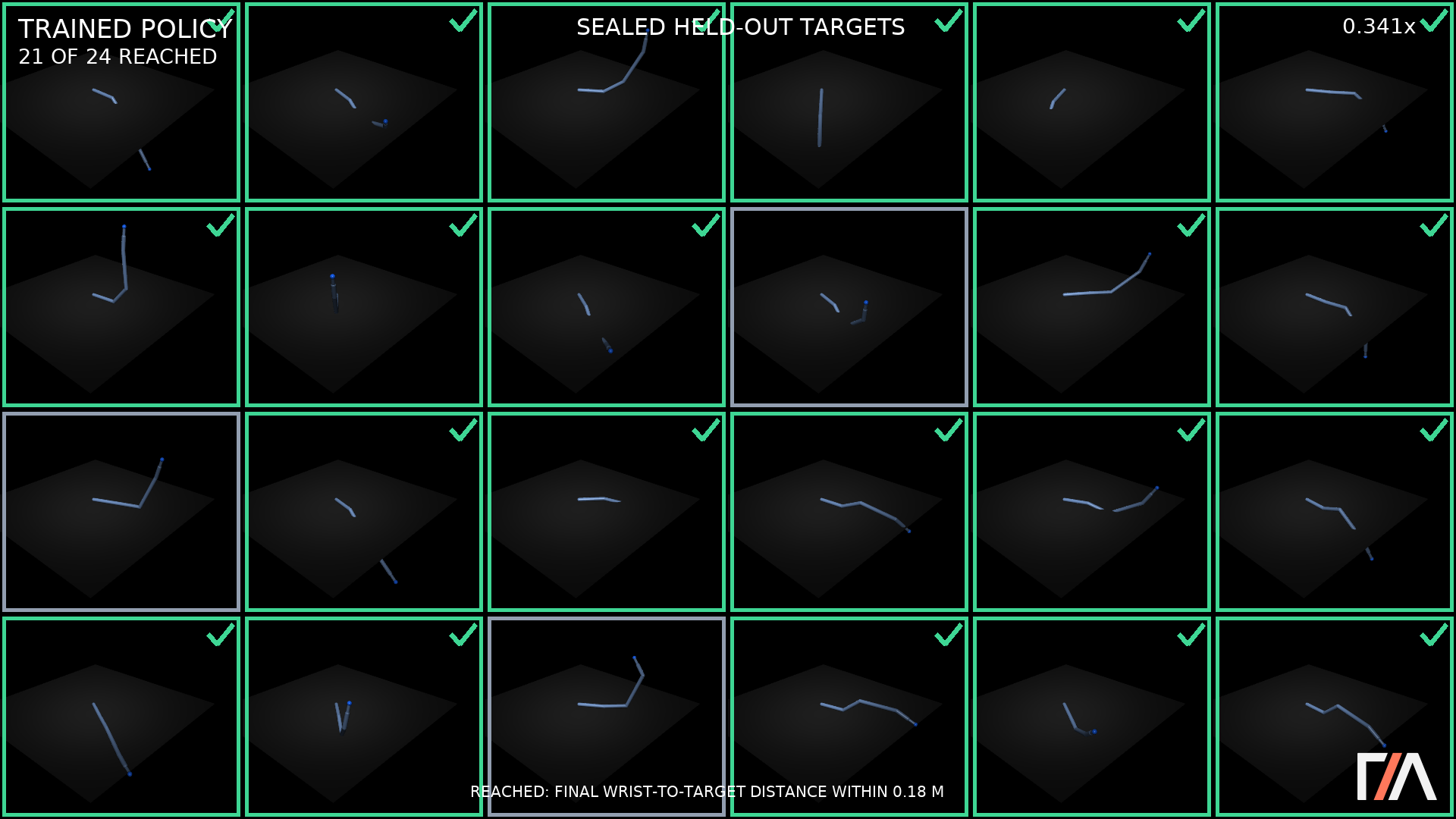
Video transcript
00:00 to 00:08
Trained policy
Sealed held-out targets
21 of 24 reached
Reached: final wrist-to-target distance within 0.18 m
0.341x
00:08 to 00:12
Untrained initialization
Sealed held-out targets
0 of 24 reached
Reached: final wrist-to-target distance within 0.18 m
0.683x
00:12 to 00:20
Evaluated envelope
Simulation, zero-gravity primary regime, one embodiment
486 of 600 motions, over the pre-registered 24-90 mm commanded-stop standoff distribution
Evidence provenance
- Competence trace
sha256:8ff3c00f122a7eb169d8acd9b4880594bf4c4435e81271cf25c28e16b598f252- Baseline trace
sha256:8c2531756f53ed54d6608885f258c4d89083d4d0703e4babc78df13b262c1e27- Engine
bfb3edc4efa8c3bcb9af53904dc28fa00b62b100- Command
kairos robotics reproduce- Root manifest
sha256:183be1e0e697aeda9212f3f2d164fad3c0fcb458754c6c59e0fa8776b64f9d4c- MP4
sha256:59498624d84beee51d2b1374a013db1c603fb180e66a0c7c5676c354b13d109c- WebM
sha256:708c1a4a0dd895a6bc7b06a3ef06baa975f437deea2a71f9888c4e380ff93df7- Poster
sha256:b5721266e1e1ccab3f30c6f404ce7922c4a14b4f666a2a7a0ea9076d5f645dec
The same property carries the commercial weight. Certification, liability, insurance, and acquisition diligence each underwrite a machine on evidence, and KAIROS makes that evidence a byproduct of every motion the machine proposes.
Safety and Evidence First
The Rosetta Robotics adapter is shipping to design partners ahead of general availability. Active pilots focus on safety-critical physical environments.
Control engineers, safety compliance teams, and physical AI researchers are also welcome to reach out. Submit your details or use the Contact tab.
Request received. We'll be in touch.